This month’s Headbangers Book Club Official Selection is a special one, as it’s the first book we’ve read that’s not a total sausage party! Pamela Des Barres may not have been a rock star in her own right (unless you count her brief stint in the Zappa-sponsored girl group the GTO’s), but her memoir I’m with the Band is a vital counterpoint to the male-dominated hijinks of ’60s and ’70s rock; plus there’s a couple of real questionable relationships with preteen boys, so it fits right in with our previous selection in even more ways than expected! We’ll be back in a few weeks with Part 2. Thanks for listening!
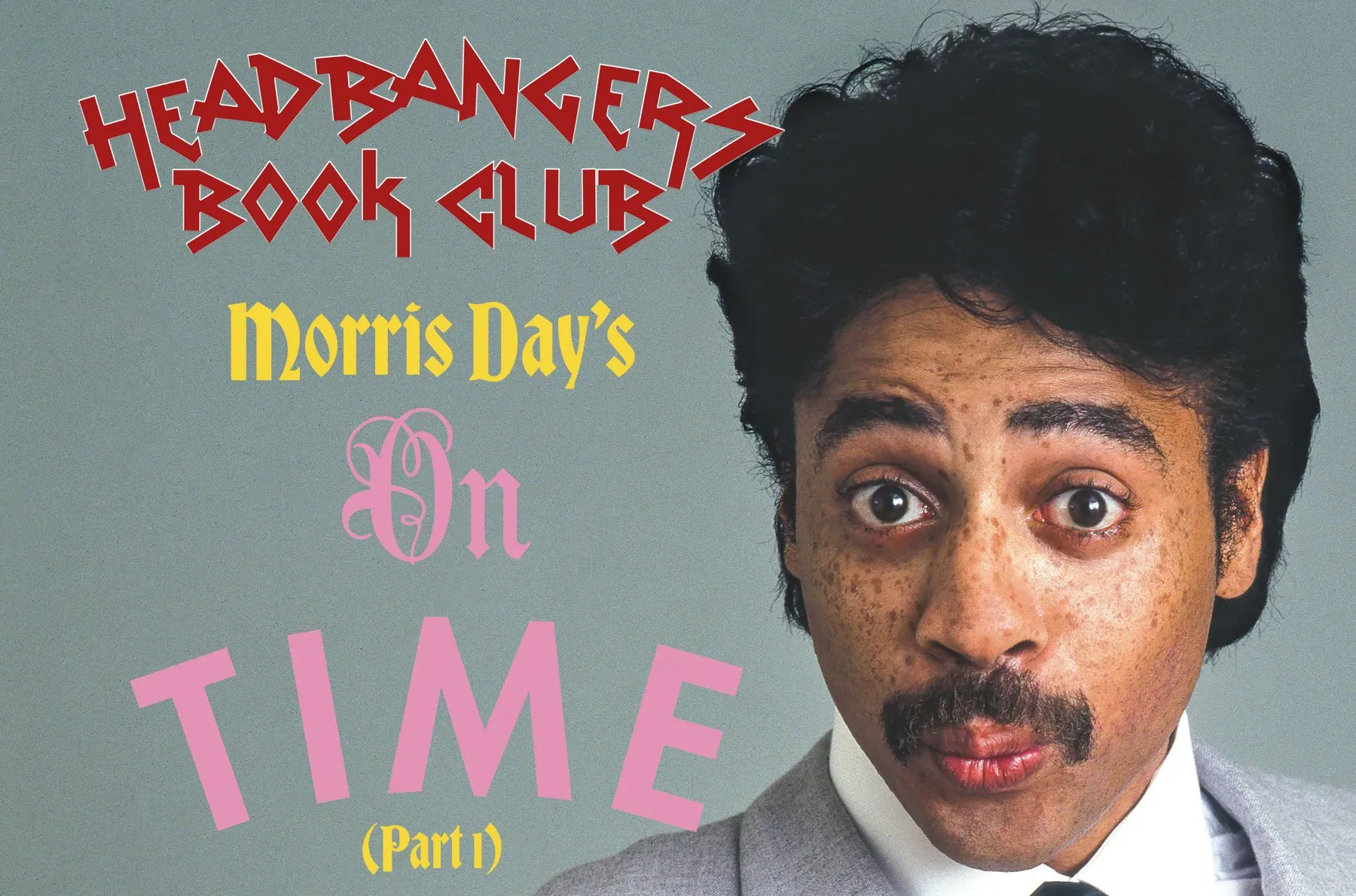
It’s a special #jhericurljune installment of the ol’ Book Club as we dig into 2019’s On Time: A Princely Life in Funk by Morris Day with David Ritz–so, slightly less headbanging than normal, but don’t worry, there’s plenty of the important stuff (i.e., cocaine). We’ll be back in a couple of weeks with Part 2, at which point we’ll also announce our official HBC selection for July. Remember, don’t let us Meat Loaf!
Hey mothertruckers, we’re Bach in the saddle with Part 2 of our series on Sebastian Bach‘s 18 and Life on Skid Row! This book really picked up in the second half, so please excuse the slightly flabby runtime; there’s just too many good stories for us not to discuss them. Join us again in two weeks when we discuss the first half of the late Meat Loaf‘s To Hell and Back! Rock it up!
The end of our year-long immersion in the filmography of Mike Myers is in sight; but hoo boy, is this final stretch a test of endurance. Our penultimate film is 2008’s The Love Guru: the movie that finally put Mike’s career out of its misery after The Cat in the Hat roughed it up and left it for dead. Join us as we discuss the unfathomable depths to which Ben Kingsley sinks in his performance, and repeatedly refer to Romany Malco as “Romany Falco.” But really, who cares? Nothing matters! God is dead, long live Pitka!
It’s an experimental episode this time around, as we try to kill two birds with one stone by watching Shrek the Thirdat the same time as we record the podcast. The results are… not great, especially since Zach sounds like he’s recording from a really large open bathroom (don’t worry, he’s not). Still, rest assured that the experience of listening to us watch Shrek the Third can’t possibly be worse than the experience of watching Shrek the Third alone! We’ll be back at the end of July with a more traditional (for better or worse) episode on The Love Guru.
We’ve talked a fair amount about Prince, who would have turned 63 today, as one of the architects of the genre we call Jheri Curl Music: Most notably in our very first Jheri Curl June Special back in 2014, but also in various JCJ entries and profiles on his former colleagues (Sheila E, the Time, Jimmy Jam and Terry Lewis, Vanity, Wendy & Lisa, Jesse Johnson, and André Cymone), rivals (Rick James and, depending on when you ask, at least half of the previous list), and even a few knockoffs (Phil Collins, Ebonee Webb). In fact, we’ve talked so much about Prince on here, you’d be forgiven for wondering if there’s anything else about the Purple One we could possibly have to say (and that’s not even mentioning Zach’s long-running, exhaustively-detailed blog about him).
The thing about Prince, though, is not only is his extant body of work both massive and exceedingly deep, but it’s also constantly growing, as more and more of his music is liberated from his storied Vault. Case in point: his version of “Jungle Love,” a 1984 hit for side project the time after its appearance in the Jheri Curl Cinema landmark Purple Rain, wasn’t even circulating on the robust bootleg market before 2019, when it was released on the posthumous compilation Originals.
“Jungle Love” is actually a Jheri Curl milestone in more ways than one. Aside from being penned by Prince and made famous by the Time, it was also based on an instrumental demo by guitarist Jesse Johnson, whose 1985 “Be Your Man” has the distinction of being the second song ever highlighted for Jheri Curl June. As for the song itself, it’s one of the greasiest of Prince’s early-’80s peak as Jheri Curl progenitor par excellence: an infectious workout driven by a lubricious keyboard line, squelching bass-synth, and rhythm guitar so clean it sounds like it’s still in the shrink wrap. So happy birthday, Prince; here’s to another five years (at least!) of more Jheri Curl gems being unearthed.
We’ll be back tomorrow! Spotify and YouTube playlists below:
So, let’s begin with the elephant in the room. As you might recall, last year the month of June began mere days after the police murder of George Floyd in Minneapolis, which made the idea of a semi-irreverent celebration of dated Black music and hairstyles by two privileged White people feel… tone-deaf, to say the least. It was also, of course, less than three months into a once-in-a-lifetime (knock on wood) global pandemic… long story short, we just weren’t in a party mood. But now it’s a year later; and, while the copsstillhaven’tstopped killing Black people–nor, despite what our respective homestates‘ governors apparently think, is the pandemic over–I think we could all use the mood lift that only the smoothest, silkiest ’80s R&B can provide.
For those of you who are new here (or just need a refresher), “Jheri Curl Music” is our name for a specific brand of glossy, heavily synthesized post-disco R&B music from the early-to-mid ’80s–it’s kind of like our yacht rock, except not even 1% as successful or widely recognized. For details, see our original introduction post from 2014, our 2016 video, or our 2018 podcast. We dedicate each June to celebrating this unsung art form: mostly because “Jheri Curl” and “June” are nicely alliterative, but also because early summer is the perfect time to roll down your windows, let the wind blow through your hair (or, if you’re rocking a J.C. yourself, let it blow kind of against and around your hair), and blast some vintage J.C.M.
This year’s Jheri Curl June is a back-to-basics move for us. There will be no long-form artist/producer retrospectives (like we did for Prince, Michael Jackson, Jimmy Jam and Terry Lewis, L.A. Reid, Jesse Johnson, and André Cymone), no Jheri Curl Cinema features (like we did for Purple Rain, The Last Dragon, Moonwalker, and Coming to America), and no special podcast episodes; just a J.C.M. song every weekday for the whole month, with Spotify and YouTube playlists for your listening pleasure. Still, that doesn’t mean we can’t spend our seventh year stretching the boundaries of what belongs under the J.C.M.-brella. That’s why this year, I’m kicking things off with a possibly controversial choice: Eddy Grant’s 1982 reggae-funk hit “Electric Avenue.”
On the surface, reggae and Jheri Curl Music don’t appear to have much in common, aside from their general origins in the African musical diaspora. Hell, just look at each respective genre’s trademark hairstyle: Jheri curls, as has been well established, are glossy and determinedly non-kinky; meanwhile, Rastafari locs (a.k.a. “dreadlocks”) embrace the organic textures of African hair types. Jheri curls have a well-earned reputation for being synthetic and potentially damaging to Black people’s hair follicles (not to mention their furniture), while locs are (rightfully) celebrated as a “natural” hairstyle and an expression of pan-African pride.
And yet, “Electric Avenue” is proof that even styles as diametrically opposed as these can exist in harmony. Oh, sure, Eddy Grant probably wouldn’t have been caught dead with activator in his hair; but who needs an actual Jheri curl when your keyboards are as moist and juicy as the ones on “Electric Avenue”? Meanwhile, Grant’s lyrics–a righteously angry ode to the 1981 uprisings against racist policing and systemic poverty in Brixton, South London–show that Jheri Curl Music, like reggae, can have a political point of view. As far as this writer is concerned, “Electric Avenue” belongs right next to Paul Laurence‘s “Racism!!!” on any self-respecting J.C.M. protest mix.
Speaking of mixes, below you’ll find Spotify and YouTube playlists for this month’s festivities, which we’ll update with every new track. Unfortunately, the Spotify list is currently empty, as “Electric Avenue” does not appear to be available on the service. We can’t blame Eddy Grant, if this was his choice: a banger like this is worth a lot more than the fraction of a cent a Spotify stream earns. But I think we can all agree that our playlists are a little bit weaker for its absence. See you tomorrow!
The bad news is, we’re a day late for Month 4 of our year-long deep dive into the cinematic oeuvre of Mike Myers; but the good news is, the movie we’re discussing may just be the best of the bunch. Austin Powers: International Man of Mystery holds up surprisingly well, and feels in retrospect like Myers’ peak as a singular creative voice. It’s all downhill from here, folks! We’ll be back later in January for what will likely be a much more sobering look at the 1999 sequel, The Spy Who Shagged Me; in the meantime, though, this is our happening, baby, and it freaks us out!
After another nearly year-long hiatus, the Dystopian Dance Party podcast has returned with something literally no one asked for: a year-long deep dive into the cinematic ouevre of Saturday Night Live alum/man of a thousand catchphrases/notorious Hollywood diva Mike Myers. In this first episode, we delve into Mike’s pre-feature film career and (sort of) explain why we’ve been possessed to do this. Come for the cracks about Cat in the Hat, stay for the clips of ’70s and ’80s Canadian TV shows!